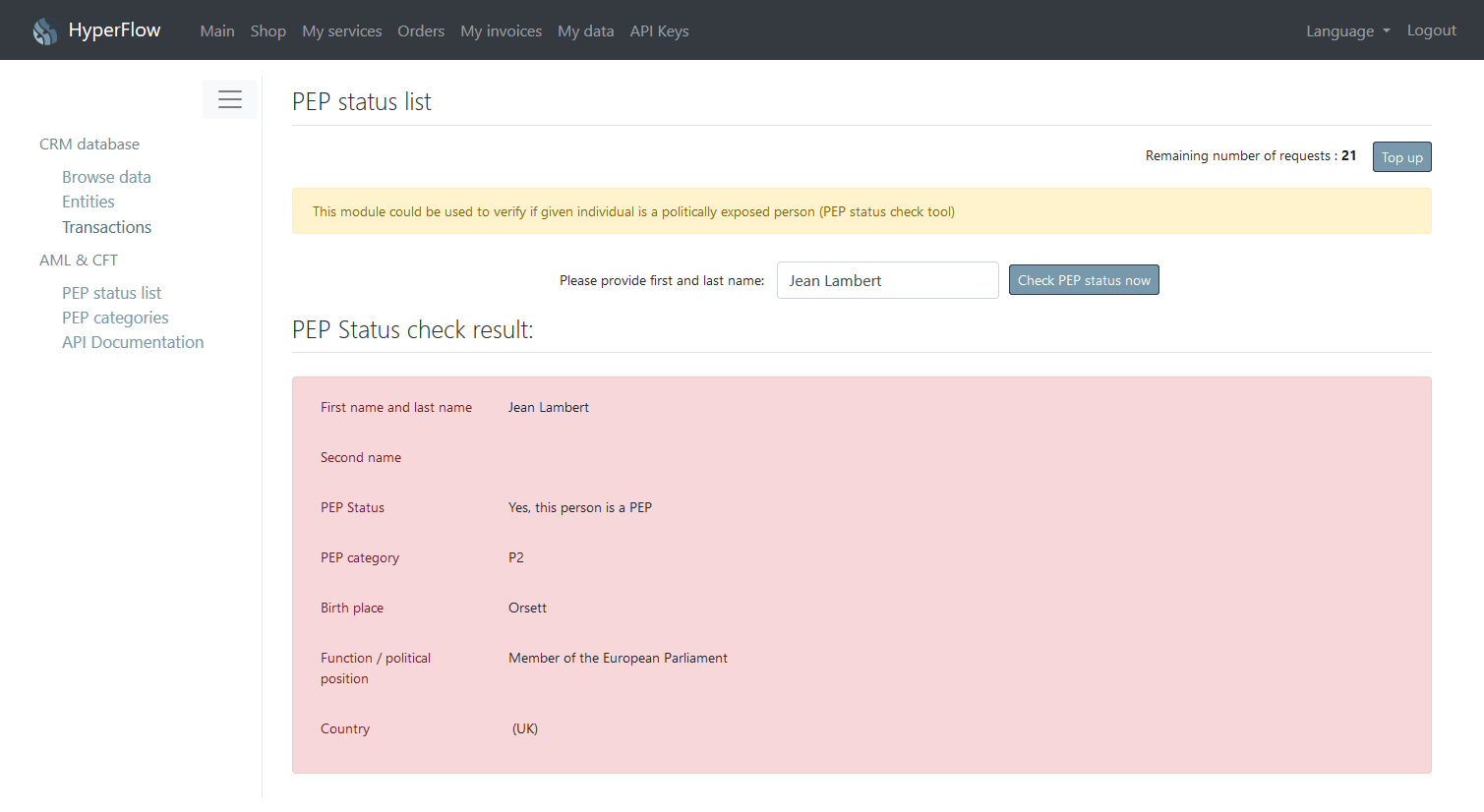
Who is PEP - legal definition of PEP

In United Kingdom the legal definition of the Politically Exposed Person could be found in The Money Laundering, Terrorist Financing and Transfer of Funds (Information on the Payer) Regulations 2017, published in 2017 No. 692. Politically exposed person aka PEP means an individual who is entrusted with prominent public functions, other than as a middle-ranking or more junior official 35(12), which is a definition adopted from UE Regulations in this matter.
The definition from EU Fourth AML Directive is exactly the same list of functions and public positions:
Politically exposed person’ means a natural person who is or who has been entrusted with prominent public functions and includes the following:
(a) heads of State, heads of government, ministers and deputy or assistant ministers;
(b) members of parliament or of similar legislative bodies;
(c) members of the governing bodies of political parties;
(d) members of supreme courts, of constitutional courts or of other high-level judicial bodies, the decisions of which are not subject to further appeal, except in exceptional circumstances;
(e) members of courts of auditors or of the boards of central banks;
(f) ambassadors, chargés d'affaires and high-ranking officers in the armed forces;
(g) members of the administrative, management or supervisory bodies of State-owned enterprises;
(h) directors, deputy directors and members of the board or equivalent function of an international organisation.
No public function referred to in points (a) to (h) shall be understood as covering middle-ranking or more junior official
Why should you investigate PEP status?
UK & European Union regulations require that special attention be paid to transactions and activities of persons who are employed in exposed political positions.
The reason for this approach is that such persons have access to public money and their specific rights create a much greater risk of corruption activities.
Persons on prominent political positions participate both in legislative work related to the adoption of new legal acts in force in the UK and the entire European Union, as well as are employed in ministries and subordinate departments that implement the provisions of these laws.
The theoretical but potential involvement of a person in a politically exposed criminal activity causes that all such persons should be subject to special diligence measures when examining such a person.
EU and UK AML legislation behind PEP screening
PEP screening in the United Kingdom is rooted in the Money Laundering, Terrorist Financing and Transfer of Funds (Information on the Payer) Regulations 2017 (MLRs 2017), supervised by the FCA and HMRC. The UK definition of a politically exposed person was itself adopted from EU rules, and although the UK has left the European Union, its AML framework remains closely aligned with the EU one. This matters for any firm operating across both markets: UK legislation and EU directives share the same core concepts of PEPs, relatives and close associates (RCA), and enhanced due diligence.
AMLD6 and the new EU AML package (2024)
The term "AMLD6" is a common source of confusion, because it covers two different things:
- AMLD6 - Directive (EU) 2018/1673 - the "criminal law" directive, adopted on 23 October 2018 and transposed by 3 December 2020. It harmonises the definition of money laundering offences and the penalties across the EU. It does not set out KYC/CDD procedures or the PEP definition, which came from AMLD4 and AMLD5.
- The revised AMLD6 - Directive (EU) 2024/1640 - part of the EU's 2024 AML package, covering national supervisors and beneficial ownership registers.
The 2024 package (the "AML Single Rulebook") was published on 19 June 2024 and entered into force on 9 July 2024. It consists of three acts:
- AMLR - Regulation (EU) 2024/1624: a directly binding regulation with uniform CDD and PEP rules; it applies from 10 July 2027.
- New AMLD6 - Directive (EU) 2024/1640: national institutions and registers; transposition deadline 10 July 2027.
- AMLA - Regulation (EU) 2024/1620: the new EU Anti-Money Laundering Authority in Frankfurt, operational since mid-2025, with direct supervision from 2028.
For PEP screening, the AMLR harmonises and widens the rules. It extends the PEP definition to heads of regional and local authorities in units of more than 50,000 inhabitants, adds siblings to the family (RCA) definition across the whole EU, and requires Enhanced Due Diligence for at least 12 months after a person leaves office, followed by an individual risk-based assessment.
What this means for UK firms
Because the UK did not adopt Directive 2018/1673 or the 2024 package, UK obliged entities continue to rely on the MLRs 2017 and FCA guidance. However, UK firms that serve EU clients or EU residents must still align their screening with the EU Single Rulebook, for example by screening siblings and senior local officials. Running automated, up-to-date PEP checks is therefore essential to stay compliant across both the UK regime and the evolving EU framework. You can test how PEP screening works with our free online PEP check, or read more about AMLD6 on AML4.eu.
When should you check if your client is PEP?
Basically, the due diligence process requires that at the beginning of establishing a relationship with the client, check whether the person does not occupy such a position.
Later, during the relationship with the client, it is necessary to periodically check whether the person has not obtained or lost PEP status.
By the client, we understand not only the personal involvement of the individual. The regulations state that in the case of entities with legal personality, which are not natural persons, all the actual beneficiaries of a given company or organization (UBO) should be verified for the status of PEP. In the event that at least one of UBOs is PEP, an enhanced due diligence procedure should be applied to such a client.
To automate this compliance process, use our online PEP screening tool to run an instant PEP check on your clients.
What are the categories of people with PEP status ?
Our solution does not only provide verification service if the given person is PEP. In addition, each of the persons on our list is assigned to one or more categories, that describe the nature of the position on which the person is employed.
In our system, we distinguish the following categories of people on politically exposed positions:
P1
P2
P3
P4
P5
P6
P7
P8
P9
Each time you perform a search query (WWW application or API) - in the case of a positive answer (it is PEP) you will also receive - assigned categories to such a person.